Shopify vs WooCommerce: Which Is Right for Your UK Business in 2026?
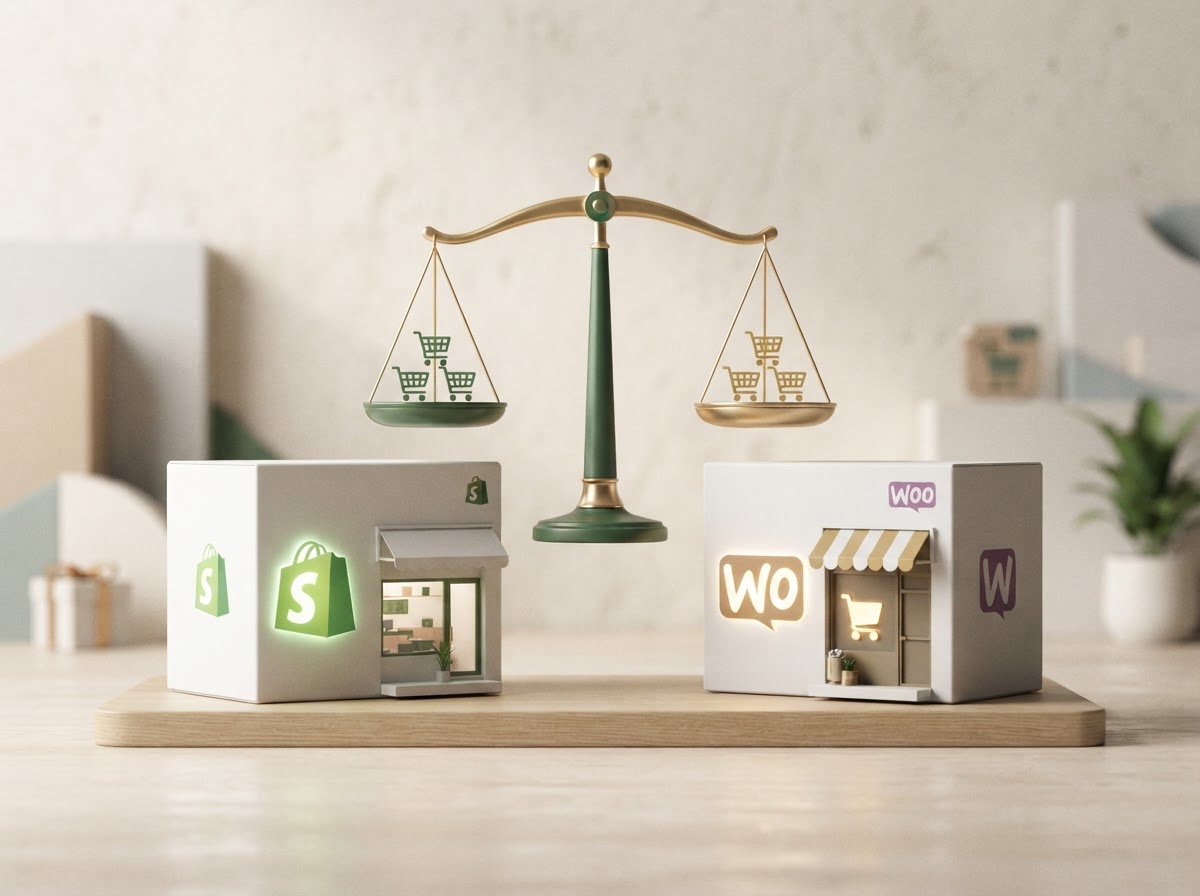
Two platforms power the majority of UK e-commerce stores. Shopify has around 28% of the market. WooCommerce has closer to 38%. Both are capable. Both have built businesses turning over millions of pounds. Neither is objectively better than the other.
The right choice depends entirely on what kind of business you are running, how technical your team is, and what you want your store to do in three years rather than three months.
Here is the honest comparison.
What Each Platform Actually Is
Shopify is a hosted platform. You pay a monthly subscription and Shopify handles everything underneath: the servers, the security updates, the payment processing infrastructure. You log in, build your store, and sell. You never touch a server.
WooCommerce is a plugin for WordPress. It is free to download, but running it properly is not free. You need hosting, a domain, an SSL certificate, and usually a handful of paid plugins to replicate functionality that Shopify includes by default. You own the code, the data, and every decision about the infrastructure it sits on.
That distinction matters more than any feature-by-feature comparison. Shopify trades control for convenience. WooCommerce trades convenience for control.
The Real Cost Comparison for UK Businesses
This is where most comparisons mislead people.
Shopify costs for UK businesses in 2026:
The Basic plan is around £25 per month on an annual subscription. The standard plan is around £65 per month. You will likely need apps on top — email marketing, reviews, loyalty programmes, advanced reporting. A typical Shopify store with a handful of apps ends up costing between £50 and £200 per month in platform costs.
Transaction fees are worth understanding. Shopify Payments charges 2% plus 25p per transaction on the Basic plan. If you use a third-party payment gateway instead of Shopify Payments, you pay an additional 0.5% to 2% on top of whatever that gateway charges. For a UK store doing £100,000 per month in revenue, that additional fee alone can cost £500 to £2,000 per month.
WooCommerce costs for UK businesses in 2026:
WooCommerce itself is free. Running it is not.
Quality managed WordPress hosting costs between £25 and £80 per month. The £5 per month shared hosting plans that work fine for a blog will not handle e-commerce traffic reliably. Add a premium theme (£50 to £200 once), essential plugins (£100 to £400 per year), and any development work for customisation and your real annual cost starts to become visible.
For a straightforward WooCommerce store with decent hosting and a handful of paid plugins, budget £1,000 to £3,000 per year in platform costs. For a more complex store requiring ongoing developer support, significantly more.
The honest summary: at low volumes, WooCommerce is usually cheaper. At scale, WooCommerce can save serious money, particularly on transaction fees. But the cost savings only materialise if you have the technical competence to manage it properly. A poorly maintained WooCommerce store on cheap hosting is not saving money. It is losing sales.
Ease of Use
Shopify wins this clearly. You can have a functioning store live in a day without touching any code. The interface is genuinely intuitive. Customer support is available around the clock.
WooCommerce has a steeper learning curve. Installing WordPress, configuring WooCommerce, choosing a theme, installing plugins and making sure they do not conflict with each other requires either technical knowledge or someone you trust to handle it for you. Updates need managing. Plugin conflicts happen.
If your team has no web development experience and no budget to hire someone who does, this difference matters enormously. A store that takes three months longer to launch because of technical problems is a store that has been losing revenue for three months.
SEO: Which Platform Ranks Better?
Both platforms can rank well. The platform itself is not the ranking factor. Your content, technical foundations, and backlinks are.
That said, there are genuine differences worth knowing.
WooCommerce, running on WordPress, gives you more granular control over technical SEO. Plugins like Yoast or Rank Math provide detailed on-page optimisation tools. The URL structure is flexible. Blogging is native and deeply integrated, which matters significantly if content marketing is part of your e-commerce growth strategy. Our SEO services are built to leverage these technical advantages.
Shopify handles the basics well and prevents most common SEO mistakes. Page speed is consistently good because Shopify controls the infrastructure. The main limitation is that URL structures are partially locked. Blog functionality exists but is less powerful than WordPress.
For a content-first e-commerce brand that plans to drive significant organic traffic through blogging and editorial content, WooCommerce on WordPress is the stronger foundation. For a product-first store where content is secondary, Shopify's SEO is more than sufficient.
Performance and Speed
Shopify pages load quickly by default. The platform's infrastructure is optimised specifically for e-commerce. UK customers typically see load times under two seconds without any additional optimisation work.
WooCommerce performance varies. A well-optimised WooCommerce store on quality managed hosting matches or beats Shopify on speed. A store on cheap shared hosting, running thirty plugins with an unoptimised theme, can take five or more seconds to load. Five seconds is conversion suicide. Studies consistently show that each additional second of load time reduces conversion rates materially.
The practical implication: if you choose WooCommerce, budget for proper hosting. This is not optional.
Customisation and Flexibility
WooCommerce wins here, with caveats.
Because it is open source and built on WordPress, WooCommerce can be customised to do almost anything. Unusual checkout flows, complex product configurations, bespoke integrations with UK fulfilment partners or ERP systems, highly specific post-Brexit VAT and shipping logic. All of it is achievable.
Shopify can also be customised extensively through its app store and through Liquid, its templating language. The 8,000-plus app marketplace covers most requirements. But you are working within boundaries that Shopify sets. For most UK businesses those boundaries are not constraints. For businesses with genuinely unusual requirements, they can be.
The honest question is whether your business actually needs the level of customisation WooCommerce enables. Most small and medium UK retailers do not. They need a store that works reliably, loads quickly, and does not require a developer every time something breaks.
Who Should Choose Shopify

Shopify is the right choice if:
- You are launching your first online store and want to focus on selling rather than technical management.
- Your team has no web development experience.
- You need to be live quickly.
- You are selling a straightforward product range without complex configuration requirements.
- You want reliable performance and support without managing a technical stack.
Who Should Choose WooCommerce
WooCommerce is the right choice if:
- You already have a WordPress website and want to add e-commerce to it.
- You have access to reliable WordPress development support.
- Your store requires unusual customisation that Shopify's ecosystem cannot accommodate.
- You are building a content-heavy brand where blogging and editorial SEO is central to your strategy.
- You are processing high volumes and want to avoid Shopify's transaction fees.
The Migration Question
Many UK businesses start on Shopify and migrate to WooCommerce as they grow. The reverse also happens. Neither direction is straightforward. Product data, customer records, order history, URLs, and SEO value all need careful handling in any platform migration.
If you are thinking about migrating from one to the other, it is worth speaking to a specialist web design agency before committing. The right migration executed well is worth the investment. A poorly executed migration can lose search rankings, customer data, and months of trading.
Frequently Asked Questions
Is Shopify better than WooCommerce for UK small businesses?
For most UK small businesses starting out, Shopify is the more practical choice. It is faster to launch, easier to manage, and requires no technical knowledge. WooCommerce is better suited to businesses with existing WordPress sites, technical resources, or specific customisation requirements that Shopify cannot meet.
Is WooCommerce free in the UK?
The WooCommerce plugin itself is free to download and install. Running a professional WooCommerce store is not free. You will need to budget for hosting (£25 to £80 per month for quality managed WordPress hosting), a domain, SSL, and paid plugins. Total annual platform costs for a properly run WooCommerce store typically sit between £1,000 and £3,000 depending on complexity.
Which is better for SEO: Shopify or WooCommerce?
Both platforms can rank well in UK search results. The platform is rarely the deciding factor in rankings. Your content quality, technical foundations, page speed, and backlinks matter far more. WooCommerce on WordPress offers slightly more flexibility for technical SEO and content-heavy strategies. Shopify provides a solid, consistently fast foundation that prevents most common SEO errors.
Can I switch from WooCommerce to Shopify or vice versa?
Yes, but it requires careful planning. Product data, customer records, order history, and URL structures all need migrating correctly to preserve SEO value and trading continuity. It is advisable to work with an experienced agency rather than attempting a platform migration without specialist support.
Which platform do UK e-commerce agencies prefer?
It varies by agency and by project. Shopify is popular for launch speed and client ease-of-use. WooCommerce is preferred for complex or content-heavy builds. A good agency will recommend the right platform for your specific business rather than defaulting to whichever one they happen to know best.
Need help choosing the right platform?
If you are building or rebuilding an e-commerce store and are not sure which platform is right for your business, we are happy to give you an honest assessment based on what you are actually trying to achieve.
Talk to our e-commerce team